
This is a guest post from my husband, Jason. Jason’s favorite hobbies are Peloton (Best Peloton Instructors Based on Your Mood), talking finance (Budgeting for your baby) and wine.
Rooted in Passion
Living only an hour from Napa and Sonoma, Barbara and I have developed an interest in rich, structured, heavy, complex wines. Rarely a month goes by when we don’t find ourselves exploring the region for a day trip or if we’re lucky enough, a night away. We got engaged in Napa, married in Sonoma. Needless to say, our love goes deep for good wine. This passion has led us to visit other wine regions in California like Paso Robles and Santa Barbara, in other states like Willamette Valley, and even a special trip to France to spend a few days in Bordeaux. Our latest adventure took us to Italy, where we dove into Tuscany’s wine scene, and I’m excited to share this cab lover’s guide to tuscany.
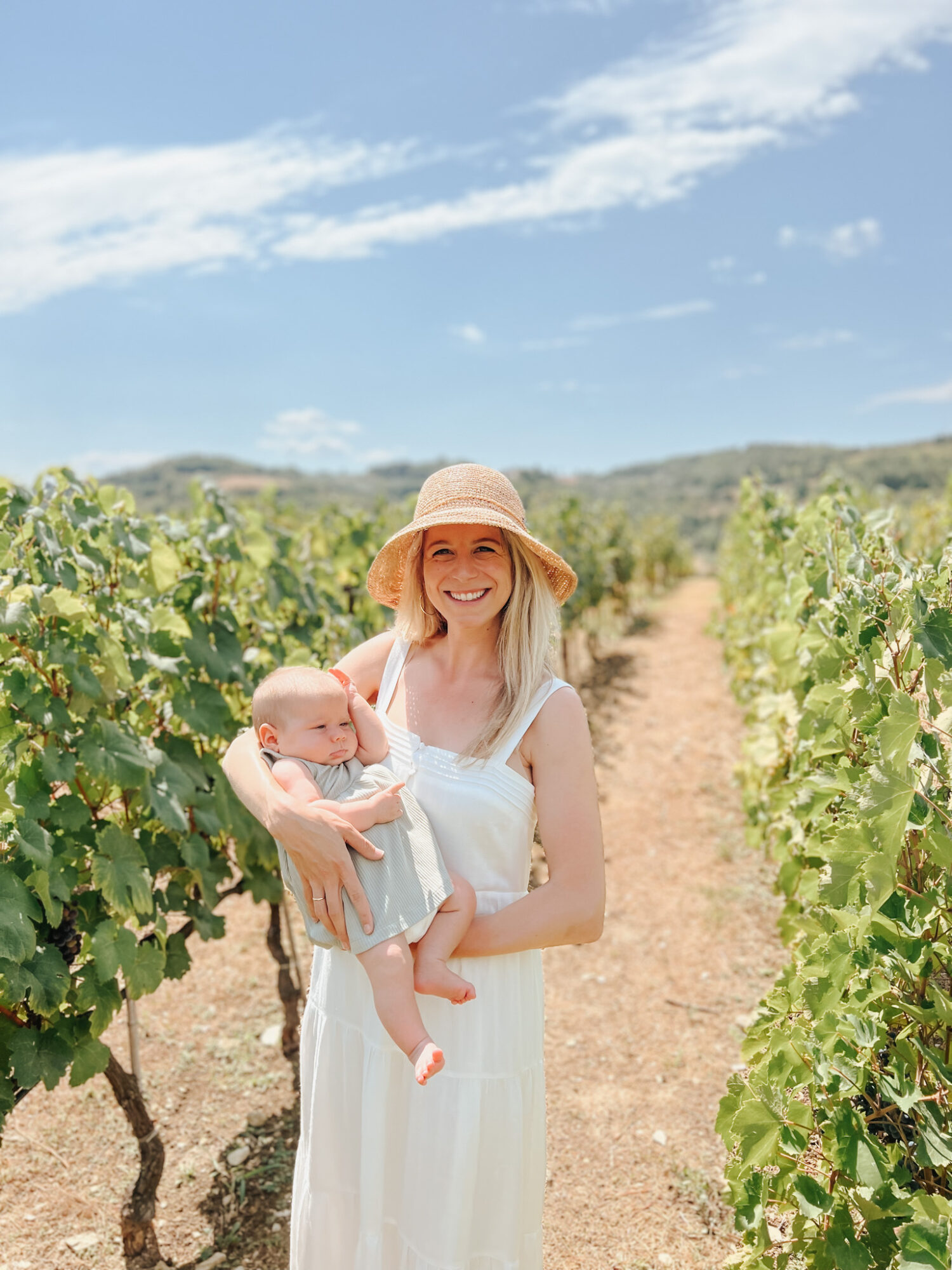
During our parental leave we decided we were just crazy enough to spend three weeks in Tuscany with a two month old, and two year old. We made it our mission to visit over 15 wineries and try something like 60 wines before we lost count, and that doesn’t even include the unlabeled homemade wine from our Agriturismo. If you love Napa and Sonoma wines like we do, it’s important to understand what you’re drinking, what to look for, and how wine works in Tuscany.

TLDR: if you like cabs like us, stick to Brunellos from Montalcino or aged Super Tuscans from Bolgheri. Avoid Rosso or table wine. If you’re curious to learn why… read on. Or if you just want to jump to the Tuscan wine recommendations list at the bottom, be my guest.
Climate and Region of Italy
Italy has vastly different wines depending on the area. The boot-shaped peninsula borders the Mediterranean Sea which has the most impact on the climate. The north has moderate summers and very cold winters while the south has very hot summers and more moderate winters. The farther south you go the more ripe and luscious the wines become. Tuscany is the most famous wine region of the country (and quite possibly the world).
Tuscany takes their wine very seriously. Even if you don’t share the locals' affinity for their particular wine, it’s important to do your best to respect their efforts and passion.
No, Chianti is Not a Grape
Wine may rival pasta in being the ultimate importance in Italy. Sangiovese is the star. Here’s how to understand wine labels, where you won’t necessarily find any mention of the type of grape in the bottle:
- “Poggio Amorelli Chianti Classico” is from Chianti (the region between Sienna and Florence), from the producer Poggio Amorelli. Chianti Classico must be made from at least 80% Sangiovese grapes, but doesn’t need to detail what the other grapes that comprise it are on the label.
- “Villa i Cipressi Brunello di Montalcino” is Brunello from the area of Montalcino (all Brunello’s are from Montalcino), and from the producer Villa i Cipressi. Brunello must be made from 100% Sangiovese.
Wine Regulations
There's a hierarchy of Italian wine classifications, and with each step up, wines are bound by more stringent restrictions on the blend of grapes, years aged, method of aging (big barrels, smaller barrels called Barriques, stainless steel barrels, or bottle) and location. At the entry level, you have ‘Vino'—that's simple table wine. If you order the house red or white at a trattoria in Florence, this is what you get. You may also see it called “Rosso”. These are red wines aged only a couple of years in steel tanks and the bottle.
One step up, and the bottle will have the letters IGT: this stands for Indicazione Geografica Tipica. These wines follow broad rules about production and what grape varieties are allowed from the area the wine comes from.
If you see DOC on the label, it's another step up: certified Denominazione Origine Controllata. And at the highest level, Italian wines will be labeled DOCG: Denominazione Origine Controllata e Garantita. DOCG is meant to represent the most prestigious and restricted wines in Italy.
To give the example of Chianti Classico – which by the way is not made in all of Tuscany, just the area between Florence and Sienna, they have “Rosso”, “Chianti”, “Chianti Classico”, and “Chianti Classico Riserva”. Chianti must be at least 75% Sangiovese and alcohol at least 11%. Chianti Classico must be 80% Sangiovese, 12.5% alcohol, and 12 months in oak barrels. Riserva must be in oak for two years and at least three months in the bottle.
We found that Brunello di Montalcino had the strictest rules. Brunello has to age for at least 5 years before it can be sold, minimum two on wood and four months in the bottle. Brunello Reserve has to age for six years. This, as well as the soil and clone variety is probably why we enjoyed Brunello above the rest while traveling through Tuscany.
WTF is a Super Tuscan
Each region is known for their own grape, but by far the most popular in Tuscany is Sangiovese. Its clones can be known as brunello, prugnolo, morellino, nielluccio, sanvicetro and sangioveto. It is not to be confused with Primitivo which is also known as Zinfandel (often people confuse them – Sangiovese is its own variety).
It’s really important to note that DOCG is meant to indicate “better”, but it may not be true in all cases. We found that many “Super Tuscans” we enjoyed were IGT. So what is a Super Tuscan? Super Tuscan wines vary in style, but the influence of Bordeaux is apparent in their use of new oak barrels and French grapes like cabernet sauvignon and merlot in addition to sangiovese. The best Super Tuscans IMO are rich and full-bodied, with well-integrated tannins and spice from oak, and can age for decades. In other words – It really can be any red wine from Tuscany blended with Merlot or Cab Franc and does not fit into the DOCs strict rules.
In Tuscany we found that we really didn’t love 100% Sangiovese wines. We found them to be over harsh, acidic, and at times sulfurous. Those that blended Merlot or Cab Franc tended to be much more soft and approachable. Those that blended Colorino (as the name suggests are mostly just for color as Sangiovese is typically lighter), did not really add anything for us. Chianti Classico and Nobile di Montepulciano wines were fine but we didn’t find them to knock our socks off. Brunello on the other hand we felt were more developed and had the structure our Napa taste buds were looking for.
Bolgheri, the lesser known Tuscan wine region
While Nobile di’ Montepulciano, Chianti Classico, and Brunello di’ Montalcino are the most famous Tuscan areas, we actually found that Bolgheri was by far our favorite. In particular a producer called Ornellaia. For the price we felt it by far stood out and this winery takes a very similar approach as Bordeaux in many respects including calling their wines by “first growth” and “second growth”. Their top of the line “Superiore” runs around $240 and their second growth which we enjoyed just as much is closer to $50. Even their third line called “Le Volte” was enjoyable at $30.
Bolgheri’s red wines are generally a base blend of Cabernet (Sauv or Franc) and Merlot, often with additions of Syrah, Petit Verdot, and Sangiovese. Bolgheri Superiore and Bolgheri Sassicaia represent the highest quality production that are followed by Bolgheri Rosso (one year aging, no oak required – not our taste given the nascency).
Are you seeing a trend? If it’s called Rosso, it will be less expensive and less aged. If you like that then great, if you want more structure, it will cost you but we feel it's worth it.
Most wine menus in Italy are overwhelming so narrowing it down each time to the Bolgheri region saves a lot of time and usually brings it down from 50+ options to 10 or less. Then of course you need to use Vivino to decide which is the best bang for your buck as well as how others describe the wine. We tend to look for the more heavy black jammy fruit (vs red fruit), deep purple, leathery, high oak, dusty descriptors.

Not to be missed: Vin Santo
At the end of every meal in Tuscany, you will see the menu something called Vin Santo. It is not a varietal or a pastry, it’s a deliciously aged dessert wine. Unlike many dessert wines in the US, Vin Santo is not fortified. Instead it is made from grapes that are picked at the end of harvest, usually in October or November and then hung up to dry into raisins, and only then pressed for that precious juice. It must be aged a minimum of three years, four for reserve, but you will find most aged 10+ years in Italy.
The taste of Vin Santo ranges from dry to semi-dry and semi-sweet to sweet and the minimum alcohol content is usually 15.5%. The storage and aging potential can be enormous, mostly from 10 years up to 20 years.
We didn't discover how amazing Vin Santo was as an after dinner digestive until our third week, but once we did we were addicted. It always comes with delicious almond biscotti cookies which goes perfectly with the sweet dessert flavor of the musky aged wine. Its the perfect way to end a meal. If you look around, you’ll see that almost every local Italian gets Vin Santo. So trust me, do as the locals do.
Final Words of Wine Wisdom
One last thing to note, avoid 2014 for all Italian wine. It was a rough year for all of Tuscany and most places have already finished or sold it off, but just in case, keep an eye out.
Tuscan Wines to Try & Buy
Here is a list of the wines or producers we tried that we both remembered to write down and enjoyed enough to share.
Bolgheri and Toscana
- Ornellaia Superiore
- Ornellaia Le Serre Nuove
- Ornellaia Le Volte
- Grattamacco
- Donna Olimpia
- Le Sode di Ant’Angelo Sotto la Quercia Costa Toscana
- Tenuta San Guido
- Castello di Bolgheri
- Caccia al Piano
- Le Macchiole Paleo
- Fattoria le Pupille Saffredi
- Biserno Bibbona
- Antinori Tignanello
- Antinori Tenuta Guado al Tasso Cont’Ugo and Superiore
Brunello di Montalcino
- Villa i Capressi
- Casanova di Neri
- Poggio Sant’Arna Colleoni
- Agostina Pieri
- Castello Banfi
- Podere Le Ripi
- Altesino Winery
- Lisini Ugolaia
- Antinori Pian delle Vigne Vignaferrovia Riserva
Nobile di Montepulciano
- La Braccesca Sabazio
- Icario Vitaroccia
- Poliziano
- Serraglio Riserva
- La Bertille
- La Ciarliana
- Dei Maria Caterina Dei
- Tanagatta
- Palazzo Vecchio (eat at La Dogana Enoteca)
Chianti Classico
- Tenuta Casenuove
- Poggio Amorelli
- Quercetto di Castelina
- Antinori
I hope this saves you some time and tempts you to try something new.
Jason, New Modern Dad


Author


