



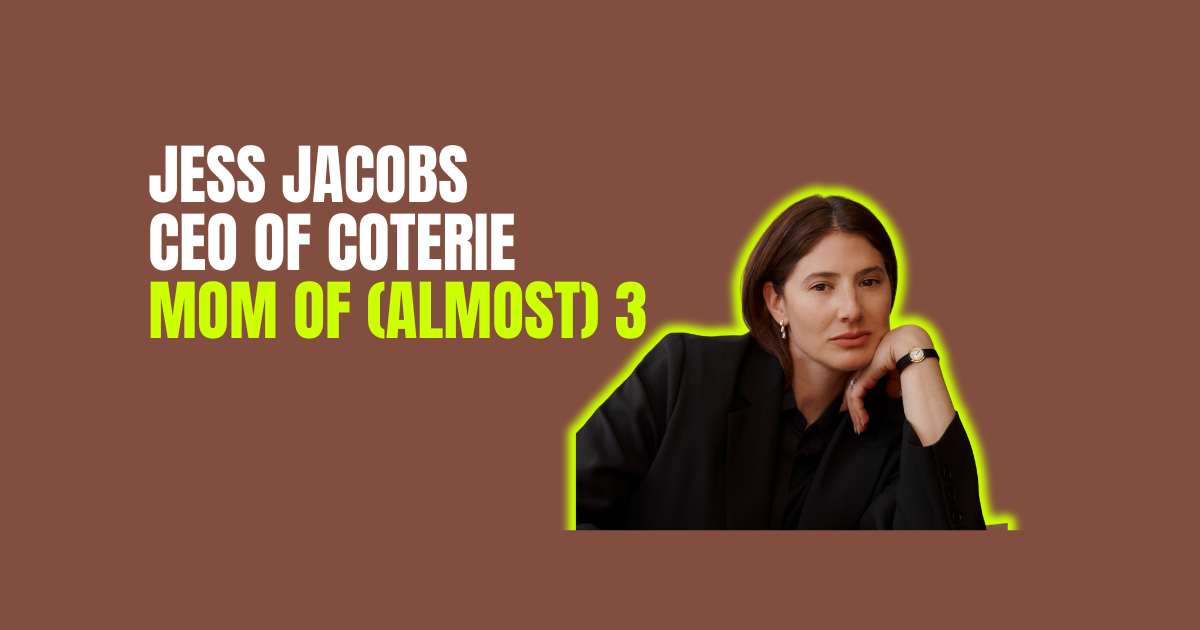
She was a copywriter. Then a creative director. Then she stepped into the CEO seat at Coterie and closed a billion-dollar acquisition, all while parenting two young daughters, with a third on the way. This is not the traditional CEO résumé, and that's exactly the point.
The New Modern Mom Podcast is back, hosted by me, Barbara Mighdoll. This episode is a candid, behind-the-scenes conversation with Jess Jacobs, CEO of Coterie, about what it actually takes to lead a hyper-growth company through a career-defining deal while running a household with a husband who also has a demanding career. Jess doesn't come from finance or a traditional operating background, she comes from brand and creative, and she makes the case that this “non-traditional” path, combined with treating motherhood as a real professional asset, is precisely what made her a stronger leader.

🎨 From Creative Director to Billion-Dollar Acquisition CEO
Making the leap from creative leadership to the corner office requires leaning into your unique perspective rather than trying to fit a traditional corporate mold. Jess Jacobs shares how staying brand-first and embracing vulnerability about her strengths allowed her to set a clear vision and empower her team to lead Coterie to major milestone achievements.
“Understanding that no CEO is perfect at nor has a background in every single thing that they oversee is step one. And then step two is leading with a vulnerability there and being clear about what my strengths are, what my strengths aren't, and really trusting the team to deliver on the vision I could set forth and the goals I could set forth in the areas where I felt less strong, and also holding hands with me to truly educate me on all of these aspects. And I think what being creative-led, brand-led does allow me to do is see the forest through the trees.”
🛑 Strategic Editing & The Power of Saying No
Protecting a company's vision means staying disciplined and turning down opportunities that might yield short-term gains at the expense of long-term brand equity. Jess Jacobs draws on her background as a creative editor to explain why having the confidence to say “no” to traditional playbooks acts as a crucial moat for business growth.
” I think another thing is I've always had the confidence to say no. That's just a personality thing maybe. But so much of my background is in editing, and editing really just means saying no, and having the confidence to do so, not following a traditional playbook and being true to what your vision and strategy is, and being okay with sunsetting or not pursuing other priorities that could in some way borrow from that, not build on it.”
🌐 Thriving in a Remote-First Workplace
Building authority, trust, and credibility in a fully remote environment hinges on consistent communication tools and a supportive corporate framework. Jess Jacobs details how Coterie’s remote-by-design structure has created an environment where working parents can excel without sacrificing executive visibility or performance.
“I really believe in remote work and specifically what it can do for parents and moms. But the culture of the business of the company and the way it's set up, it has to be supportive of that too. They need to work hand in hand. It's not just all on that remote employee to make themselves visible and heard and all of these things. It needs to be an environment that is set up to do so.”
🏡 Dual-Career Household Logistics
Balancing two demanding careers alongside a growing family requires moving away from rigid silos and leaning heavily on shared communication. Jess walks through the daily realities of managing her home, highlighting the deep support network, from family to nannies, that keeps everything running smoothly.
“Honestly, it's overcommunication. He and I are on every text chain together with everybody, so we're both able to see what's happening, jump in, and communicate. There's nothing going on in a silo. Everything from the lovely college student that helps us with the driving to our nanny to everyone. We're both in it together and on any given day, at any given time he can jump in or I can jump in, and we figure that out.”
💡 High EQ, Communication, & Energy Management
Effective leadership relies on emotional intelligence and treating communication as a continuous, two-way dialogue rather than a broadcast. Jess Jacobs emphasizes why clear alignment is essential both in business and at home, and why ruthlessly declining optional commitments is necessary to keep your energy battery charged.
“I think the key with communication is it's constant and it's a conversation. It's a dialogue. It's not a monologue. It's not me shouting out wishes. It's a true back and forth on what's possible here, what we are seeing, finding alignment on those higher goals within the range of possibilities.”
Listen to the episode
Want bonus tools and takeaways?
For exclusive bonus tools and takeaways from our guest, Jess, subscribe to the newsletter: [newmodernmom.com/subscribe]
And connect with Jess on Linkedin here.

Rather read the full interview than listen?
Jess: [00:00:00] being a mom is a superpower. And I think it has totally transformed how my brain works, how I prioritize things, how I compartmentalize, my leadership style, everything.
Barbara: Today's guest is someone I have been really excited to sit down with. She is the CEO of Coterie. She just led a billion-dollar acquisition, and she is doing all of it with two young girls at home.
Jess Jacobs, welcome.
Jess: Thank you so much. You're so sweet. I'm so happy to be here and be talking to you. It's my honor, so thank you.
Barbara: So before we get into everything, I wanna give our listeners who do not know you a little context. So tell us who you are personally and professionally, what you've built, what you're running right now, and how you'd describe this season of life.
Jess: Oh, my. Okay. Personally and professionally, we'll start personally, which bleeds into professional, as it does, but I am a mom [00:01:00] of two. I have a third on the way, actually, right now. So it'll be three girls, which is really cute and exciting. That, in many ways, shapes a lot of my personal life and my perspective on my professional life.
Number one, because- I'm fortunate enough to be CEO of Coterie, and we're reimagining the future of baby care and being there for families, and that's what I get to live and experience all the time myself. And also because I think being a mom is a superpower at work. I really do. And I think it has totally transformed how my brain works, how I prioritize things, how I compartmentalize my leadership style, everything.
So the two are quite interwoven.
Barbara: And how would you describe this season of life with one on the way and holding this title?
Jess: You know, they say the only constant is change, and I'm embracing that i- in every way, and [00:02:00] enjoying it too. I feel fortunate that I get to live a really exciting and fulfilling existence personally and professionally.
And even on harder days, trying to find that gratitude and perspective is critical for me.
Barbara: Such a good reminder. Joy, joy is definitely the point. So you joined Coterie in 2021. You went from SVP of brand to CEO, and then you closed a billion-dollar deal. Yeah. When I look at that, I keep thinking how does one actually do that?
Yeah. What experience and mentality does someone have that made them get that kind of career jump? So if you had to distill it down, what are those three skills that you use to get to where you are today? Not the general stuff, like the very specific things- Yeah … that are your strengths, unique to you.
Jess: Okay. Good question. I think first, you said it, but my background is [00:03:00] in creative. I was a copywriter and then a creative director for a, a very long time, and I think leading with that creative-led strategic vision was a differentiator for me and I think for our business in a lot of ways. And I think being different now i- is more important than ever, honestly.
What that translated to, I think, is us being very brand first, consumer centered. Expressive, communicative, beautiful, all the things that I think weren't always prioritized as a business focus. And I think it created this amazing moat for our brand. I think also another thing is I've always had the confidence to say no.
That's just a personality thing maybe, but so much of my background is in editing, and [00:04:00] editing really just means saying no and having the confidence to do so, not following a traditional playbook and being true to what your vision and strategy is, and being okay with sunsetting or not pursuing other priorities that could in some way borrow from that, not build on it.
Things like prioritizing our D2C first model, really allowing that customer relationship to lead in sacrifice of some faster growth we could have had, but we did the right thing there, and I stand by it. We stand by it. I think the last thing, and I, I touched on this in the beginning, but being a mom and just being able to be human-centered, which is like a weird word, but I think leading with empathy, trust, support, and showing up as my whole self in that way is also I think a superpower.
Barbara: On [00:05:00] the saying no piece, you and I share that in common. I've got no problem saying no, but I realize that actually is a skill most people do need to develop, and I'm curious if you have a way in which you deliver that news to your team when you're shutting down an idea or telling people to move on.
Jess: So I think it happens in every direction, but with my team it's actually quite easy because it's a conversation, right?
It's an opportunity to really communicate and get at something and poke holes and ask the right questions, and sometimes my mind is changed. Absolutely. But in other cases, everyone comes to a different rationale maybe, and it's a less pushy way of getting to the no. But I said no to bosses and managers, and if I really just don't believe in something, I can't sort of back it.
It was scary to do that at first, but I think that with the right context in place and [00:06:00] rationale, it's respected, and I respect it when my team does it to me
Barbara: Definitely. It sounds like you lead with curiosity through those conversations instead of just jumping to the chase. And like you said, sometimes your mind can be changed.
Jess: I try, and more often than not, maybe my mind is changed.
Barbara: I wanna stay on the career piece for one more minute, because as you said, you did start off as a creative, which you think is really lent itself to being one of your superpowers in how you made that career jump. But there is a real gap between being a creative director or SVP of brand and running a full company.
Like, those are very different jobs. So for our listeners who dream of taking that CEO title one day, or maybe they're in a leadership role now and they're dreaming of starting their own company, what did you have to figure out when you stepped into the CEO role that you didn't need before? What was new?
Jess: Good question. Almost everything was new, I have to say, and for better or worse. But [00:07:00] I think coming to the realization that every CEO comes from a specific background. Typically, it's finance or marketing in the performance sense maybe, or You know, whatever. Less so is it creative or brand. You don't hear about that as much.
I certainly don't. But understanding that no CEO is perfect at, nor has a background in every single thing that they oversee is step one. And then step two is leading with a vulnerability there, and being clear about what my strengths are, what my strengths aren't, and really trusting the team to deliver on the vision I could set forth and the goals I could set forth in the areas where I felt less strong.
And also holding hands with me to truly educate me on, on all of these aspects. And I think what being creative-led, brand-led does [00:08:00] allow me to do is see the forest through the trees and ask the right probing questions that can sometimes get to that finer point in a P&L that maybe I don't have the background to truly dig into, but I can understand when something doesn't feel right, and then start investigating the cause, the solutions, bring together the right teams to make something happen, push things out of their way so that they have the runway to make that thing happen and can prioritize it, have the tools and resources to do so.
All of those things. It's being a coach, really.
Barbara: And on the topic of trust, of course, you have to surround yourself with people who are very good at all of those other jobs that maybe are not your strengths. Yeah. What does trust actually look like? Like, how does that show up on your calendar? How are you meeting with your team?
What do those meetings look like?
Jess: It shows up on my calendar with less meetings, I'll be honest, right? I want these [00:09:00] incredibly intelligent, motivated, special people around me to be able to have the freedom and flexibility to do what they do without my micromanagement. And I've been in situations where I've been micromanaged and- it's awful
It really is. And it's demotivating. It's all the wrong things. And if I'm ever in a position as CEO where I need to micromanage, we have bigger issues there. But I think that really clear communication, everybody understands where my head is, where my expectations are, what are the top priorities for the business at, at a given time.
I'm communicating those things ad nauseam. So I've been really fortunate to just have great people around me that can put things to action with my trust there.
Barbara: And it sounds like that communication piece has been a huge unlock. And so I'm curious, what does your communication cadence look like? Is this, like, you presenting a vision?
Is it you reiterating it in email, Slack channels? What is that communication protocol for you?
Jess: It's all of those [00:10:00] things. I wish it, I wish it could just be one channel, one time. I think the key with communication is it's constant, and it's a conversation. It's a dialogue. It's not a monologue. It's not me shouting out Wishes, it's a true back and forth on what's possible here, what are we seeing, finding alignment on those higher goals within the range of possibilities.
And then constantly in meetings, over the phone, over email, Slack, everything, digging into them, getting updates on them, making sure that there's nothing blocking anybody from being able to execute on those things. Communication is something that I do believe is a strength For myself, and I use it all the time to my advantage.
And I feel like if miscommunication is an issue for so many parts of life, communication is the an- antidote there.
Barbara: So on the topic of communication then, [00:11:00] your career progression and this giant acquisition happened in a remote setting, which I think is a very relevant part of your story, and very relevant topic right now in general for working women.
Yes. So you're not in an office every day. No. You are not in the room a lot of the time, and yet you still manage to build credibility and get promoted. So many women listening are working from home, they're in hybrid situations, and wondering if that is holding them back. Hmm. So
Jess: what
Barbara: worked for you? What behaviors did you lean into to
Jess: build that visibility?
I really believe in remote work, and specifically what it can do for parents and moms. But the culture of the business, of the company, and the way it's set up, it has to be supportive of that too. They need to work hand in hand. It's not just all on the remote employee to make themselves visible and heard and all of these things.
It needs to be an environment [00:12:00] that is set up to do so. And at Coderly, we've been remote from the very beginning. Pre-COVID, always remote. So when the pandemic happened and other companies needed to make this huge shift, it was not a huge shift here because we'd already been remote. And I think, again, because everybody is and it's not a hybrid situation, we all rely on the same constant tools and resources for that constant communication.
So we're Slacking all the time. We're very used to doing everything in Zoom, including brainstorms and things of that nature. We're also reserving quite a healthy budget for individual teams and the whole team to get together in person too, and I think that's an important element of it as well. But we're a team of a lot of parents, and this is what has [00:13:00] really been easiest for us, and I find it highly productive.
So I guess I can't opine with every business, but it really works for us and it really works for me.
Barbara: And I think having such like-mindedness when it comes to a lot of your team being parents obviously helps- Yes … with empathy and understanding work hours and communication efficiency, I would imagine.
Jess: And it goes back to trust again, right?
Everybody that's here is a really high-performing adult, and there's trust that- No, we're not all on the same hours. No, we're not obviously in the same place, but we lean on each other to get it all done, and it always gets done. So I appreciate and always have appreciated the flexibility there and the trust there, and I believe that this team does too.
Barbara: I wanna switch completely, because everything you just described is happening while you have two little kids at home. One is in kindergarten, one is two, and you just shared that you have one on the [00:14:00] way. Yes. And you also have a husband who has a very big job as well. Yes. So I wanna know exactly how your household runs.
What are the systems that are holding everything together, like the person or the routine, that if it disappeared, everything would fall apart?
Jess: Oh, I was gonna make a joke that like, no, we- my husband and I just do everything. No, we don't. We can't. A- and I think acknowledging that and understanding that is a beautiful thing too.
We ask for help and need help all the time. And at this point in life, that's just the way it is, and that's okay. I'm super lucky with a lot, but specifically, I have my family really close by. My sister and her whole family live in the same town as I do, as does my mom. It's super fortunate. We have an incredible nanny who's been transformative, and sometimes I have help from the local wonderful college student who helps drive my girls to activities if I can't make it.
And it's a [00:15:00] lot of pieces to this puzzle that make it happen, but I think at the end of the day, it's again, my husband and I being great communicators too, and just- Ensuring that with all the moving pieces, they're covered in some capacity. And then also allowing ourselves to not always get it right a- and be okay with that, too.
Barbara: Definitely. I want you to walk me through a Tuesday. Who is doing what, even before the kids wake up, to bedtime, to what happens after the kids go to bed?
Jess: A Tuesday, my husband is not working from home. I am. So the night starts when he gets home from work. Now that the weather is really nice, we've been doing later in the day swims with the kids, which is really cute and fun, and it gets some last-minute energy out, and we're really fortunate to have a pool and be able to do that.
But it, it's a really fun thing. We'll bring their dinner outside and sort of picnic by the pool. Then we'll bring the girls upstairs. [00:16:00] We'll bathe them, do the whole rigmarole, read books. He'll then typically pop downstairs to start making us dinner. He's an amazing cook. Again, I'm v- very fortunate. And I'll cuddle up with the girls and put them to sleep.
That's a typical Tuesday in the summer.
Barbara: I love that you can swim after with the daylight out still. It's so nice. I saw you had to pause for a moment and were putting together the pieces of what day it was and where you were versus where your husband was. Like, where do you keep all of this information stored?
Is it in your mind, you guys just know?
Jess: I absolutely should have better systems and processes in place at home, the way that I rely on them so much for work, but I just don't. And I think that allows it to be a little bit more flexible and free, and put a little less pressure on myself a- and my husband to make sure it's all perfect.
Barbara: Definitely. And you did mention you have a nanny, and then you have also [00:17:00] some help from a college student. How are you dividing up the responsibilities between your nanny and this additional kind of driver?
Jess: So my nanny doesn't drive, so it's very easy to just split that up and,
Barbara: yeah. And is your nanny there, like, Monday through Friday?
What's her typical schedule?
Jess: Correct. Like, working hours Monday through Friday.
Barbara: Great. And you also talked about your husband cooking most of the time. Like, how do you guys approach meal planning and grocery shopping and all of that?
Jess: We try to plan that out as much as possible. It just doesn't happen, I'll be honest.
And he is a creative cook. He can scan the fridge and put something together. Like, there's always a way for him to make a really good fried rice, and it's sometimes I'm like, “What's in here? This is crazy.” And then I take a bite and like, “This is really good.” But I think the creativity helps there because there is typically not a plan, unless I'm able to run out and grab steaks or something, you know.
Other than that, it's a little bit like, “What do we have? What can he put [00:18:00] together?”
Barbara: I think that'll be really refreshing to hear for a lot of our listeners, and I also can relate. My husband is so good at everything in the kitchen, making whatever, where I'm like, I love to cook, but I need a recipe in front of me, and I get really stressed out if I can't do that.
Jess: Absolutely. It's just I love food and eating, and I know what I like, but the putting it together is just, I just don't have that instinct. I don't know what it is.
Barbara: I find it fascinating when I chat with friends about how they really divide up responsibilities between their partners, especially when it's a power couple where each person really has strong ownership and responsibilities in their role.
So when you think about who's picking up the girls if there's a sick day, or who's really making sure that the nanny's where they need to be when, like, how do you think about that kind of default parent day-to-day?
Jess: I think, again, it's the over-communication. So he and I are on every text chain together with everybody, so [00:19:00] we're both able to see what's happening, jump in, communicate.
There's nothing going on in a silos. Everything from that lovely college student that helps us with the driving to our nanny to everything. We're both in it together, and on any given day at any given time, he can jump in or I can jump in, and we figure that out and then we go to my mom if we need to, or my sister if we need to.
We've created this bench, if you will, this deep bench. You know, I don't know what we'd do without it.
Barbara: I think what you said around not being in silos is so important because I think that actually happens quite frequently. I had a guest previously on the podcast who also highlighted that her husband was in all the same text threads, all the WhatsApp groups everything. Yep. And so it wasn't like somebody knows something and somebody doesn't know it, therefore they can't contribute. So I think that's a really important thing to share that is often missed.
Jess: Yeah. And I completely understand [00:20:00] the intention of the divide and conquer. But it then can weigh quite heavy, I think, on the individual to make sure no balls are dropped in their zone.
And it, it just felt like too much pressure, I think for both of us.
Barbara: Yeah. What is one thing or things that you're intentionally not doing right now? You've looked at it and you're like, “Nope, this is not for me in this season,” and you've come to peace with that.
Jess: I think that there are definitely a lot of groups that would be interesting to join and be in, both personally and professionally.
There are CEO networks and things of that nature. There are, like, tennis groups in my town, and there's a lot of different, like, quite compelling activities, let's say, to jump into. And I just know that it would only deplete me at this moment in time, not jumpstart my battery, but rather just take away. And I know those things will be there for me at another time, and right [00:21:00] now it's not what makes sense for my sanity.
I'd rather, you know, take the 45 minutes and get a pedicure.
Barbara: Totally. I think thinking of it in terms of recharging your battery or not is a great framing for how you think about things to prioritize and not for personal or professional.
Jess: I think everything that is not necessary should recharge your battery.
Should. That's
Barbara: a good reminder. So my last question for you, Jess, I ask this on every one of my episodes. What is your professional superpower, and how has it shown up in your personal life?
Jess: I'll echo what I was talking about before around communication. It seems really simple, but so often people, I find, think that they're being very clear because they're so clear in their own heads.
And I've learned the hard way that just because you really understand something does not mean it's translated to other people or you've gotten them on board. And I think being able to really [00:22:00] clearly and confidently communicate in a way that is also open a- and curious, to use your word, has been huge for me in terms of my ascendance and in terms of everything I am learned and continue to learn.
And also, I think just an EQ to really understand people. That's the foundation for everything. And just appreciating, because I've been through it, what an amazing manager or boss or mentor can really do for you, what they've done for me, and taking that responsibility really seriously and wanting that for everybody that's here at Covery i- in one way or another.
Barbara: And so how does that really strong communication impact you personally?
\
Jess: I think it, it makes for just a ton of clarity between my husband and I, honestly. It's a wonderful partnership that- Has the space and that prioritizes constant communication.
Barbara: Yeah. I'm a [00:23:00] believer in it.
The most important team that's running everything behind the scenes, so that makes sense. Jess, thank you so much for joining us today. I loved chatting with you.
Jess: I loved chatting with you. Thank you so much, and so impressed with everything you're doing, and just honored to be here, so thank you. .
Author


