



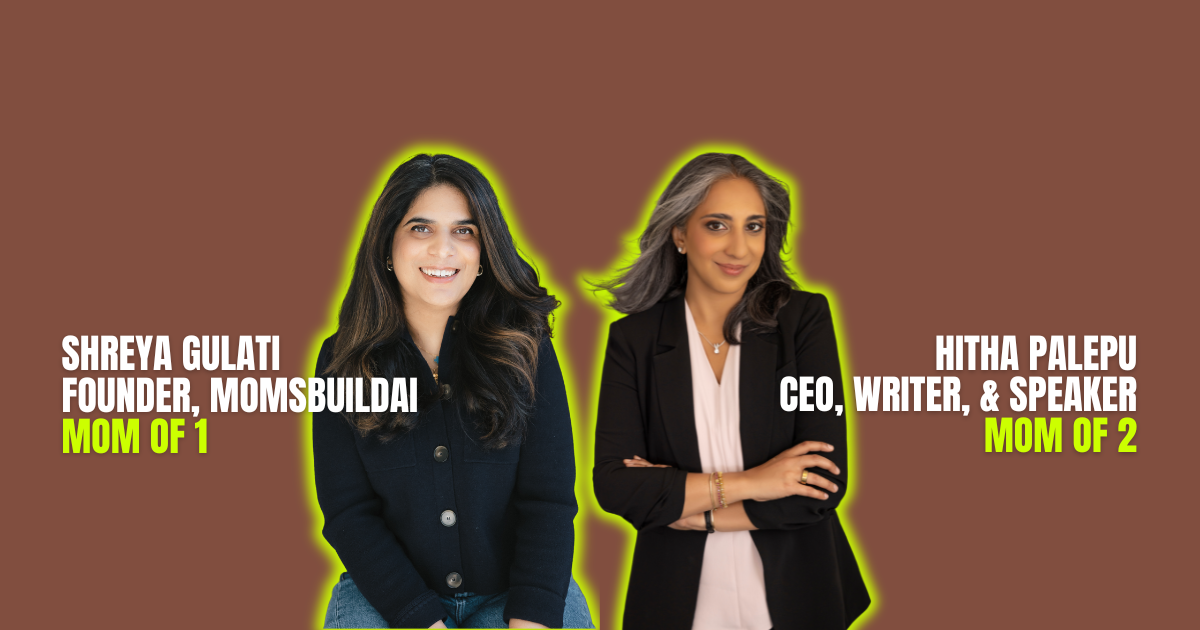
Back to school gets me every year… the forms, the emails, the schedules, all landing at once while summer's supposedly still happening. So I brought in two women who've figured out how to make AI carry some of that weight.
Hitha Palepu is a CEO in the pharmaceutical industry, an author, a speaker, a content creator, and a repeat guest here at The New Modern Mom Podcast. Shreya Gulati spent years as a tech exec before becoming an advisor, investor, and founder of the community Moms Build AI. Between the three of us we've got an 18-month-old, a 4-year-old, a first grader, a second grader and a sixth grader.

🎒 The Back-to-School Mental Load Is Bigger Than the Calendar
Back-to-school isn't just about getting everyone where they need to be. It's the emotional and mental load of remembering every detail, anticipating what's coming next, and trying to keep the whole family moving while you're still holding everything in your head. Hitha and Shreya both approach AI as a way to take some of that invisible work off your plate.
“I think back to school hits working moms in two directions. There's the tactical side of it, which is the backpacks and the lunches and the school supplies and the drop offs and pickups. And then there's the emotional side of it, which is, you know, the anxiety and the worry and the excitement that comes with a new school year.”
🧠 Build a Simple AI Stack, Not a Bigger One
Hitha has built a whole ecosystem around AI, from Littlebird and Notion to Claude and Monologue. But Shreya's approach is a useful reminder that more tools don't necessarily mean more efficiency. The goal is to create one system that actually knows enough about your life to be useful.
“The more tools in a stack doesn't make it better. And so what I've really tried to do is simplify my stack. I have Claude at the center of my stack, and then I have all of these connectors that I've plugged into Claude, like my Notion, my email, my calendar, and so that Claude can really become my knowledge base.”
🔎 Let AI Hold the Things You Can't Mentally Hold
One of the biggest shifts isn't necessarily using AI to create something new. It's using it to remember, research, organize, and remind you of things you would otherwise have to keep track of yourself. That can create a surprising amount of mental space.
“I cannot mentally hold it in my brain. And so the ability for AI to be able to hold that for me and then remind me when I need to do something or send me an invite to my calendar or whatever it is, it just takes that mental load off of me. And so I feel like I have so much more time in my day because I'm not spending time thinking about all these little things that I need to do.”
⏰ Give Yourself One Hour to Get Ahead
Before you start throwing random tasks at AI, Shreya recommends making space to actually look at the season ahead. An hour spent getting everything out of your head and onto paper—or into a system—can make the next few months feel dramatically more manageable.
“I would block one hour on your calendar, put it in your calendar, and actually take that time. And I would just do a brain dump. Everything that you are thinking about, everything that you're worried about, everything that you know is coming up, just get it all out.”
🔄 The Goal Isn't a Better Prompt. It's a Better System.
This may be the biggest mindset shift in the conversation: AI isn't just a place to ask questions. It can become part of the system you use to run your life. Shreya's four A's—articulate, audit, align, and act—give you a way to move from the chaos in your head to something you can actually work with.
“The goal isn't a good prompt. The goal is to create systems that are resilient and will survive the chaos. And so when I think about that, I think about the four A's. I think about articulate, audit, align, and act. And so the first thing is really just articulate.”
🤖 You Don't Have to Know What You're Doing Yet
You don't need to become an AI expert before you start using AI effectively. In fact, one of the easiest places to begin is simply telling Claude what you're trying to figure out and letting it help you work through the mess.
“You can literally just word vomit. You can just say, I have no idea what I'm doing. Here's everything that's in my head. And treat it like you would an assistant. You don't need to have the answers. You don't need to know what you're asking. You don't need to have a good prompt.”
😴 AI Can Help You Make Room for Rest, Too
The conversation eventually moved beyond productivity, because having AI do more isn't the point if you're simply filling the extra space with more work. Hitha uses AI to help think intentionally about rest, including the different ways we can actually recover instead of treating ourselves as the last item on the list.
“You can't just treat yourself as the afterthought. And so I started to think about, okay, how do I actually build rest into my day? And so I started using AI as an accountability partner for that. And I started to create what I call a rest menu.”
❤️ You're Not Behind. You Just Have to Start.
For the mom who feels like everyone else has already figured out AI, this is perhaps the most reassuring takeaway. You don't need to catch up on every tool, trend, or new feature—you just need to start with the problems that are actually taking up space in your life.
“I think motherhood is the hardest job in the world. And I think moms are some of the most talented people when it comes to the skills that AI needs. And so I would just say, you are never late. You are never behind. You are just starting, and you can start today.”
Listen to the Episode
Want bonus tools and takeaways?
For exclusive bonus tools and takeaways from our guests, Hitha and Shreya, subscribe to the newsletter: [newmodernmom.com/subscribe]
You can also connect with them here:
- Hitha Palepu: Instagram here | Substack here | LinkedIn here
- Shreya Gulati: Instagram here | LinkedIn here

Rather read the full interview than listen?
Barbara: Welcome to the New Modern Mom podcast. This is a special toolkit episode, meaning this will be short, specific, and built to give you something you can actually use this week. Today, we are talking about back to school season, which for me, is genuinely one of the most overwhelming times of the year, especially this year.
I just got back from six weeks in Spain. I moved homes. It's a mess behind me. My daughter's starting a new school. I have three new locations of my business opening in the next three months. There are forms, emails, schedules. I'm feeling my anxiety rising as I'm saying all of this, but luckily, I have two amazing guests here today who have both figured out how to use AI to make this season a little bit more manageable.
First, we have Hitha Palepu, who is a multi-hyphenate, and lucky enough, I've had her on this podcast before. Hitha [00:01:00] is a CEO in the pharmaceutical industry. She's an author, a speaker, a content creator. And we have Shreya Guvlady, who is an ex-tech exec, now advisor, investor, and founder of the community Moms Build AI.
Welcome to you both.
Shreya: Thank you
Hitha: Thanks for having us
Barbara: So before we get into everything, I wanna set the stage a little bit, because I think back to school hits so hard for moms in two very different directions. There's obviously, like, the tactical side, which I think is what we all think about immediately, like the information overload, the calendars, the logistics.
But there's also the emotional side to it, the mental load, the guilt, the trying to be present while you're really completely stretched, and then not to mention the emotional weight you're taking on of your kids in that transition period. So I wanna talk about both today. So let's get started with where you both are right [00:02:00] now.
What are the AI tools that you're actually using heading into back to school, and which ones do you think you're going to lean into harder when it gets really hectic? Hipa, let's start off with you.
Hitha: All right. I have a pretty modest tech stack, all things considered, and I think compared to a lot of my friends who have a much more intense one. The main tool I'm using right now is Littlebird, and like when I say I am obsessed with this tool, I am obsessed. How they manad- managed to do so much with just $11 million raised is like very impressive to me.
Littlebird is basically your second brain, and what I like about it, it's got its own agents already that they've developed within the system, so you're not building your own, like if you are when you're getting started on Claude. It's just amazing, and what it's doing is it's constantly taking snapshots of what's happening on your desktop.
So again, a security precaution that your work has to be cool with if you're using it on your work email. I personally have a complete other co- computer for my pharmaceutical work, so [00:03:00] Littlebird doesn't touch my pharma career and pharma work at all. But basically it knows me really well, and it can also almost anticipate my needs faster than I know what I need or what to respond to.
Underneath Littlebird, and I think this is the one thing I wish I had done first, is setting up a Notion database and a Notion architecture to handle anything. So much gets lost in a chat, whether it's on Claude or ChatGPT or in Littlebird, that if I know I need this to refer to this later on, I mean, my Notion's probably a mess, but I don't have to worry about it 'cause it's just there and I can recall that one idea that I wanted to take action on from just a quick conversation in a new chat.
I also do use Claude. Claude was like my first AI love. I still love you, Claude. But I'm using it more as a thought partner and a strategic partner, less so as a project manager, and you know, there's so much you can do with Fable [00:04:00] 5 in like five minutes, and it is still a powerhouse for me. I know a lot of folks love Whisperflow, but I've been using Monologue, which is from the Every suite of tools.
What I like about Monologue is it's all locally saved versus being uploaded into a cloud. I've been thinking a lot about how I do wanna diversify my tech stack and not make it all, all Claude, all ChatGPT, or on one platform too much, and I want ownership of some of my files. So with Monologue, keeping my files on my computer or on my phone gives me like some weird mental sanity, I guess.
Barbara: I'm already taking notes. That was amazing. Raya, how about you?
Shreya: So I actually have a really s- I think a simplified stack as well, and this is a caveat I wanna make for moms. The more tools in a stack doesn't make it better. A stack that you are using regularly and it's giving you time back and [00:05:00] executing, that is, like, the goal stack that we're going after. So the center of my world is Claude, and I actually lean a lot on connectors, so all the tools I can connect to my Claude.
So Claude is kind of like the central node, and then to that is connected my Notion, my email, my calendar. E- everything kind of flows through that, and the reason that really helps is that's my stack for personal or professional, and I have many lives in professional, and so I kind of need, I needed some stability in my tech stack, otherwise I think I'd lose my mind.
And so I have different projects for everything, but the tech stack actually stays pretty simple. The one note that I'll say is, like, I do casually play around with other tools. Like, I still use ChatGPT and Gemini for image generation. I do use WhisperFlow. But I think what I'm more focused on is having really…
It's actually what Hitha said, which is, like, a knowledge base that I've built either in Notion or in Docs I've written so that I do have the flexibility to ju- jump around. And so I think, you know, right [00:06:00] now my tech stack is fully dependent on Claude, but that's, but that's not a given that's gonna stay that way.
But I do think connectors is the place I would send moms, which is, like, take your existing workflow and connect it to whichever main tool you wanna use as your AI stack
Barbara: I think it's a really important point. I think everybody kind of made like the mass migration from ChatGPT to Claude this year, and in doing so, I ended up putting kind of that entire knowledge database into a document. So I do feel like I could be agnostic if something else comes up
Shreya: Which is awesome
Barbara: And I'm curious how different this feels this year going into back to school from even just a year ago.
Like, what's the biggest shift you've noticed in being able to leverage AI in this season specifically? Shreya, do you wanna start?
Shreya: So for me, I kind of think about it as like two categories. I think it's completely changed the game on research and reminders. And I'm like const- my mind is blown how much I [00:07:00] used to spend time on both these categories. And I think we underestimate as moms how much research we're doing. And, you know, I'm a fairly new mom.
I have a toddler at home. My gosh, the research on like what highchair to buy, what to ask the nanny. And so to me, when you go to back to school, like you have no time. Like you're juggling, and so you need to know that someone can synthesize the information for you, someone can do the heavy lifting of research.
So I think that's a huge one. But for me, the single biggest game changer in back to school season this year has been, I'm very type A. I don't like to drop like any ball ever, but the truth is I cannot mentally hold it in my brain. It's just not possible. And so the fact that AI can create reminders, invites, have all the details for me is huge.
And you know, when it's applying to a dance class that your kid needs to go to, like there are just so many timelines, and so I think just having that reminder, and sometime it's even it adding reminders “Hey, you can't block a meeting here because you need 40 minutes to go between [00:08:00] meetings.”
And so I if I really had to categorize it, it's m- like magical how many hours it's taken away in those two areas of research and reminders. And I think as a result, I feel lighter
Barbara: Hipha, how about you?
Hitha: One thing I did recently is just start a chat with Little Bird and said, “Ask me questions about how back to school went last year and how I'd like back to school to go this year.” And that's exactly what it did, and because it's been, you know, in my inboxes for, you know, over about a year now, it knows me well.
It knows the cadence of school emails. It knows what's a priority, what's not as big of a priority. It knows what Three handles versus what I handle. So it was being able to put together, like, an emotional plan, not just a tactical plan, on how to approach back to school. What I wanted to prioritize in terms of being home in the evenings, what kind of meals I wanted to make for the kids on those early days so it's not as much, [00:09:00] “We're back to normal, kids.”
Um, Ways to get them involved with auditing and reviewing what their uniforms are, their school assignments, summer assignments, finishing them up. A lot of what we do is conversations I have with the kids. Sometimes I'll just have a monologue, like, voice memo going, and we have a conversation about, “Okay, how are you approaching this book you need to read before school starts?
How are you approaching the math lessons you need to do?” And they are telling me what their plan is, and I'm saying, “Okay, I like this plan,” or, “I'd like to maybe give you this suggestion.” And so when they're physically writing down their plan on a piece of paper, monologue is capturing it as a voice memo.
It's being fed back into… I have a whole project in Little Bird that's just focused on kids' school stuff, and it's feeding it back into that. So I'm able to, at the end of every day, when it's giving me my end-of-day review, it's like, “Don't forget to check in with the [00:10:00] kids that they did this, they did that,” et cetera, et cetera.
So it's reminding me what the kids committed to do as well. So I'm not… That's not one more thing I'm holding in my head. It's been… school hasn't started yet. School starts in just under a month, so jury's out on how well and s- this does go smoother than it does, um, ne- than it did last year. But I am hopeful that we can kind of enter this season without as much chaos as we did last year.
Barbara: That's always the goal. And I love how you got the kids involved, which does remind me, for anyone listening who isn't familiar with either of you, what are the ages of both of your kids?
Hitha: I have two boys, 11, so going into sixth grade, and seven going into second grade
Barbara: And Shreya, how old are yours?
Shreya: My toddler is 18
Barbara: Ah, I love it. So we're getting, like, the whole spectrum. My kids are four and six. So we've got, like, every age group covered here, which I think is amazing. So let's get into the [00:11:00] most important part of this conversation, which is a real playbook for our listeners, for you at home, and it's something you can do this week, and I mean it.
I want everyone listening right now to block one hour of time. You've got an hour, I know you do, and you're going to wanna do this exercise. So what Shreya and Hitha have prepared are 30-minute exercises. This is something you can take action on and actually implement to make your life easier and to hit this point less chaotic.
We can cross our fingers. So Shreya, I wanna start with you because you're coming at this from that productivity efficiency angle, and I know everybody here is gonna wanna take notes. So you've built a 30-minute exercise that all of the moms listening can use Claude for at home.
Walk us through it
Shreya: So one of the things that I'm really trying to pivot moms away from [00:12:00] is the goal isn't a good pron- prompt, the goal is to create systems that are resilient and will survive the chaos. And the exercise I'm gonna give today, the beautiful thing about it is it can apply to any part of your life, and it can apply to different parts of back to school that might stress you out.
So maybe the plan I take you through, you apply it to meal prepping, or you apply it to scheduling, and so you can kind of pick. So the plan is simple, four A's: articulate, audit, align, and then act. Except you're not the one who has to act, it's gonna be the AI. So the first one, articulate. Brain dump with voice notes.
You can use the one on– Like you can use the mic feature in Claude, you can use Whisper, you can use Monologue. Articulate everything, your fears, what you're excited about, everything that you, like, just everything you're thinking going into back to school. And brain dump as you much can. And vent, like complain about, “This was so hard last [00:13:00] year.
This made everything more difficult.” And just kind of give as detailed and comprehensive of an articulation of just like what back to school looks like for you. And I also want to caveat, if you're doing it via voice, you can do it during a walk, you can do it while you're making coffee. Like, you don't need to take out time for this, and I think that's really important.
I also, while you're articulating, I would also give it supplemental files of just like pictures of every stupid paper you received that had a schedule on it, that had like, “Here's the outfits your kids need to wear.” Just give it all. After you submit all that, you ask AI, ” Organize, synthesize, categorize, find patterns of like what's happening here.
Like, what am I stressed about? What seems really difficult?” Because, you know, I also suggest like one of the best things you can give AI is your calendar, your spouse's calendar, and your kids' calendar. The magic that it can do with just that is really important. But the auditing feature is so important because synthesizing and organizing is something that moms used to spend so much time on.
It's [00:14:00] actually something AI can do even better. So that audit portion is really important. It's gonna actually take your mental chaos and show it to you in a way where you're like, “Okay, I think we can actually make a plan 'cause I have it laid out.” And then after you see it is a align stage, which is where I'd request, moms, if you're listening, to pick which area you wanna tackle.
And the reason I say that is I think it can be really overwhelming in 30 minutes to try to do it all. And so suppose the piece that's really stressing you out is your travel schedule and caretaking or, you know, enrolling your kids in all the extracurriculars. So just pick one, and then from there, from that point on is when the real work starts and you ask, you know, you work with Claude to be like, “Okay, is there– Like what, what system can I build here?
What repetitive task item can I build here that's actually gonna help me figure this out? And it could be essentially, you know, giving you a Monday morning text with prep for the entire week ahead so you have headway. [00:15:00] It could actually be, and this is a common one, giving your husband a text of like, “Here's everything that's happening.
Here's what I wanna cover.” But the goal is to take whichever piece and say like, “I'm not gonna think about it.” You know, in terms of meal planning, you can tackle that one, because like suppose you do all the work and you're like, “Okay, I'm actually scheduled pretty well. Like, it's hectic, but I'm scheduled pretty well.”
And you're like, “Okay, it's gonna remind me of all the calendar dates of like what day my son has to wear red or wear a Superman outfit.” And so maybe you decide meal planning, but the truth is like meal planning has to be for you and for your family. And so you can come up with a system that works really well, which is, “I'm only gonna change the menu once a month.
So on the third Monday of the month, let's start prepping for how we're gonna change the meal plan for the next month.” Or, “I need to make sure that every night's dinner is the next day's lunch. How can we have a flexible meal plan?” But I think the piece that I really wanna capture is this system of articulate, audit, align, act can be applied to anything.
[00:16:00] And so the most important thing that you're doing, even though it just feels like you're venting, is that in that articulation voice note period, you're actually building a huge second brain for your system to work off of.
Barbara: Couple follow-up questions there. In that very first step, are you– what are you telling Claude to do? Are you saying take note of this or store this somewhere? Are you just starting to talk? What does that look like?
Shreya: Yeah I think you start with, ” I'm just gonna tell you everything in my mind about back to school, and we need to– like, I need to be less stressed, I need to be more organized, I need to figure out a system.” And so you can kind of make the ask whatever, or you can just say, “I don't know what I wanna do, but I just want to tell you everything in my brain.”
And so I think the best thing you can do is treat it like an assistant and just, like, word vomit and then see, like, okay, where can this high potential assistant actually take over? But I don't wanna overwhelm moms, because I do think it's really hard to, like, in 30 minutes tactically attack every piece of back to school.
And so my [00:17:00] recommendation is, like, even if you get one system that works really well, you're gonna be like, whoosh, okay, don't have to think about it because, like, I built a system. And then slowly you can apply that to more and more things, and it just functions really well. But yeah, Barbara, like, you don't need to tell it anything.
You can actually just word vomit and Claude will actually prompt you and be like, “Okay, that's a lot. Like, should we break it down?” So you can tell it nothing. You can tell it something, but I think it's also a way in that thought exercise, you know, the audit stage is, like, where you get to really think about, like, what matters and what doesn't.
And it's a really important exercise of, like, when you're prioritizing, you're like, “Okay, like, if these three bottom things drop, I will be fine.”
Barbara: I think the one thing I wanna underscore there, which I think is what holds a lot of people back from even trying, is you don't need to have the answers, right? As you said, you just ask it to tell you what you should be thinking about. Like, you don't need to come saying, “I wanna build this system.” You can use it as a thought partner.
And I even tell my team this as well. A lot of my team is [00:18:00] very new to AI or hasn't even dabbled, and it's like, you don't need to come to AI with like, “I need you to build this.” You can go to Claude and say like, “Here's my problem. Help me work through a way that you can help me.” And if anyone's listening and not really knowing where to start, just remember like you don't need to come with the answer.
It will tell you the answer.
Shreya: And I think this is a really important point because that final stage, which is act, it can look like many things. It can look like a reminder system, it can look like a massive calendar, it can look like an agent. And one of my biggest frustrations with AI is skills and agents. These words are thrown around a lot. They are so simple in what they are. Like, you- this- a skill- I can give you a very basic skill, and I want moms to hear this. I hate how long-winded Claude can be. It's very frustrating. And I wrote a skill for Claude when I– where I said, like, “When I ask you X type of question, I want you to have this tone, channel the energy of this person, and please keep your responses no more [00:19:00] than, like, five sentences.”
And that was a skill that I inputted. And then I have a skill about, “Okay, when you make me an export, I only want PDFs.” Like, and my point being is, like, anything is a skill. And, you know, AI with Ally, she's a very f- you know, famous AI content creator. She was saying the same thing on her Instagram today where she was like, “An agent is a document that explains, like, what AI needs to do.”
And so just please don't get caught up in these words, and don't get caught up on, like, what you're gonna create at the end, because that's actually gonna be your journey with the conversation and the AI
Barbara: Absolutely. So Hipaah, I wanna come to you now because you are gonna come at this from a very different angle, and you kind of previewed this even with how you're using AI today. But I do think it's something that's left out of most AI conversations, which is it's not just about being more efficient, it's about how you're actually feeling during the season, especially in the chaos of back to school.
So walk us through your 30-minute exercise.
Hitha: Yes. This is something I came up with is very early in [00:20:00] my AI journey earlier this calendar year. It's applying this framework called the Seven Types of Rest, which was developed by Dr. Sandra Dalton-Smith, who delivered a TED Talk on this being a system and a framework to help you with burnout, with basically being a mom in America today, like the whole paralyzing exhaustion of it all.
And I implemented this as like in a form of an accountability partner in a really chaotic time in my life. Like, my uncle had passed away, one of my kids was in the hospital. It was a lot. And the fact that this system still works and has like helped me take care of myself through the most intense stretches means you could set it up today and it will help you get through back to school better than surviving, maybe not quite thriving, but feeling ultimately a lot better about yourself.
So what I did was I created a project as– was basically you're gonna be my [00:21:00] accountability partner to make sure I actually rest and I rest well. This is the framework for the seven types of rest. I want you to ask me questions about how I'm feeling, what I like to do based on what you already know about me, and help me come up with a rest menu for each day.
And when I do my daily check-in, you are going to, based on the information I give you, based on what you know about me from this context doc, give me my rest plan for the day. And it does my
Barbara: love the term rest menu. I just have to, like, emphasize that. Like rest menu. We all need a rest menu. Okay, sorry, had
Hitha: Yeah, no. So like today, like two of the types of rest is like sensory and creative, and it's like, “You're gonna needlepoint for five minutes today.” And I'm like, “Okay.” And it's like, “I will
finish this project at some point.” Half the time my, like, [00:22:00] physical rest is just drinking enough water. It's like, “You're gonna drink three cans of seltzer.”
And I'm like, “Okay.” For spiritual rest, it's like, “You're gonna listen to your woo playlist.” And I'm like, “Okay.” And it sounds so simple, but we forget ourselves in the busy seasons. And I've learned this year that it's… You can't just treat yourself as the afterthought. You have to make yourself the priority.
It doesn't mean long stretches and this, like, luxurious version of a morning routine. Sometimes it's just hiding in your bathroom for five minutes when your kids are banging down the door and screaming, ” I need a second.” And like playing some spa music and just taking like five deep breaths. But when you just put in these intentional blocks of time that said, “Okay, this is for me to just not do anything for any of you,” and to fit it in the margins versus, you know, [00:23:00] making it as big of the day as much as you might want to, something is better than nothing.
And as someone who has spent a lot of her adult life in total burnout, I have to say living this way has significantly improved my wellbeing, and it's a practice and I'm really glad I have in place as I'm going into back to school because I know how to take care of myself now and I'm able to then take care of my kids and anticipate their needs and to deal with the back to school insanity amidst like a pretty big milestone for our company happening in September and October as well.
So
Barbara: What a good reminder. That is so needed. I think both of those exercises are going to make immediate impact to everyone listening. Before we end, I do wanna go through a little rapid fire because I think there's a lot of things floating around about AI, and let's just, like, cut through that noise. So couple of questions for [00:24:00] you.
Hipa, I will send the first one your way. What is one thing people shouldn't use AI for?
Hitha: As a therapist
Barbara: Great. Shreya, what is the biggest mistake new users make?
Shreya: They give up too early. I think the way I kind of see the relationship is like they use it day one and two and they're like, “Oh my God, so good.” And then they try to build things, and I think they give up really quickly because, you know, AI actually only gets better once you train it and once you work with it.
And so there are a lot of times where I'm kind of coaching moms to be like, ” Stay a little longer, give it more information. I think you'll get there.” So I think that's a mistake people make, which is quitting too early
Barbara: Hitha, what is the most surprising way you're using AI?
Hitha: I used it to make me a brick routine to, like, lock me out of my phone. And yeah, I upload my screenshots of my screen time. I have Little Bird [00:25:00] put together a time audit for me every other week in a CSV, and I feed that back in, and I said, “Based on this, update my brick routine and update my typical daily schedule for me.”
Barbara: Amazing. The AI talking to the other technology to lock you out of the AI. It's that's amazing
Hitha: know it sounds dystopian, but since I started doing this, I have read more books, I have done more puzzles with my kids. Like, I've spent more time offline actually living, which I think is the whole point
Barbara: The needlepoint. You're doing the analog, which is obviously trending for a reason. Shreya, what is something you used to spend an hour doing that you spend five minutes now?
Shreya: Oh my gosh. So I'm in the middle of a move, and with the move comes everything, and I also had to research preschools and everything. And I have the most amazing tracker system built for that entire thing. And [00:26:00] the crazy thing to me is not the system I built, the crazy thing to me is that before AI, that would've just been in my brain and in notes in different places.
And so I think to me it's just overwhelming, like how much pressure we were putting on ourselves to like remember and organize and you know, even for like preschools, like AI could do the research, AI could do the synthesis of like the options, AI could do the… Like it could do so much to get me to the point where I was like, “Okay, I know my three favorite choices.
I know when I need to apply, I know when…” You know what I mean? It's just like every little thing that you can carve out. And so this whole process that I th- thought would be overwhelming is so manageable. But to me, the shocking thing is we just did it by ourselves before that
Barbara: It's truly remarkable as somebody who is, I wouldn't call myself on the other side of a move because look at what's behind me. But I spent five minutes yesterday researching a microwave that fits in a very small, compact area that honestly would've taken me [00:27:00] probably two hours
because it was so specific yesterday. That's great. So last question, and this one is for both of you. I know there are moms listening who feel like they are completely behind on AI and wonder if it's honestly too late to catch up. So Hifsa, what would you say to that mom?
Hitha: I would say it's not too late, and I would tell her to download Little Bird because it will get to know you more than you have to tell it anything. And that, I think, is the barrier to entry. It's, “I don't have time to sit and set this up.” There's no setup. There's just going about your day and doing your work
Barbara: You should be their spokesperson
Hitha: like, little bird, I don't need another job
Shreya: Heta has been working on this.
Hitha: Honestly, they need to sponsor, like, this podcast. They need to sponsor Moms Build
Shreya: Ja, meine
Hitha: even though this is a company built by three men, I was like, “You really built this for exhausted millennial [00:28:00] mothers.”
Barbara: And I'm downloading as soon as we get off this call.
Shreya: true.
Barbara: Freya, What would you say to that mom who is feeling really behind?
Shreya: This is what I would say. Motherhood is the single hardest job in the world. Using AI is an absolute joke next to what is motherhood. So if you are a mom, you are ridiculously talented at all the skills that you need for AI. So I would just say you are never late.
Whenever you want, you can jump in, and it doesn't even matter what you start with, but just start the minute you jump in and you realize everything can be done with natural language you'll just be in it
Barbara: It's all about perspective. Absolutely. Hitha, Shreya, thank you so much. This was exactly what our listeners needed heading into the season, and I think we're all gonna hopefully feel a lot lighter after we implement those [00:29:00] exercises.
Thanks for joining
Hitha: Thank you
Author


